


Germany’s $270 Billion Renewables Shift Biggest Since War
Germany’s $270 billion renewables shift biggest since war
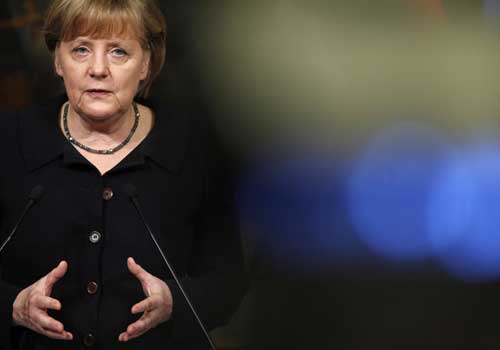
Angela Merkel, Germany’s chancellor.

Germany’s $270 billion renewables shift biggest since war
Not since the allies leveled Germany in World War II has Europe’s biggest economy undertaken a reconstruction of its energy market on this scale. Chancellor Angela Merkel is planning to build offshore wind farms that will cover an area six times the size of New York City and erect power lines that could stretch from London to Baghdad. The program will cost 200 billion euros ($268 billion), a third of annual gross domestic product, according to the DIW economic institute in Berlin.
Germany aims to replace 17 nuclear reactors supplying a fifth of its electricity with renewables such as solar and wind. Merkel to succeed must experiment with untested systems and policies and overcome technical hurdles threatening the project, said Stephan Reimelt, chief executive officer of General Electric Co. (GE)’s energy unit in the country.
“Germany is like a big energy laboratory,” Reimelt said in an interview. “The country has a political and societal consensus to drop nuclear power but lacks a clear technological solution.” Already, the program is expanding markets for Suntech Power Holdings Co. (STP), the world’s biggest solar panel maker, and Vestas Wind Systems A/S (VWS)., the largest maker of wind turbines. It’s hurting utilities from RWE AG (RWE) to EON AG (EOAN), which have stepped up cost cutting to curb losses from closing nuclear stations early.
This article is originally published in Bloomberg.